For nine decades, Lancing Bowling Club has been at the heart of village sporting life, bringing together generations of bowlers, volunteers, friends and families. From humble beginnings in 1937 to the thriving club we know today, our story is one of community spirit, determination and a shared passion for the game of bowls.
The club was founded in 1937 by local market gardener C. F. “Charlie” Pycroft and a dedicated group of fellow enthusiasts: Cliff Davies, Fred Picknell, Jack Harber, George Cox, Arthur Chubb, Jack Hillbrew, Ken Batten and George Challis. Their vision was simple yet ambitious: to create a welcoming place where local people could enjoy the sport of bowls and build lasting friendships.
The bowling green itself had been laid out the previous year by workers from a nearby market garden in the Old Salts Farm area. What began as little more than a carefully prepared patch of ground soon became the foundation for a sporting institution that would serve the village for generations.
One of the most remarkable features of the club’s early years was its pavilion. Through Charlie Pycroft’s initiative, a retired Pullman railway coach, The Princess Helen, from the Queen Victoria Fleet, was transported to the site and positioned beside the green. This unique structure served as the pavilion for both Lancing Bowling Club and Lancing Manor Cricket Club, becoming a distinctive local landmark. For more than thirty years it provided shelter, changing facilities and a place for members to socialise before its destruction by fire in the early 1970s. For many members, it remains one of the most memorable symbols of the club’s early history.
The club’s first General Meeting took place on 31 August 1937 at the Corner House in Lancing. Only a few weeks later, on 17 September 1937, the first committee meeting was held at The Manor House. At that point the club’s finances stood at the modest sum of £1.6s.8d cash in hand. While the figure may seem tiny by modern standards, it represented the determination and optimism of a group of people committed to building something special.
In those formative years, meetings were held in a variety of venues across the village, including the British Legion, the Empire Club (which had also been built by Charlie Pycroft) and the Worthing Rural District Council Offices. A particularly significant milestone came on 12 January 1938, when Charlie Pycroft and W. C. Dunk became the club’s guarantors to the Worthing Rural District Council. Their support helped secure the future of Lancing Bowling Club and laid the foundations for its long-term success.
Initially, bowling was restricted to afternoons and evenings. As interest in the club grew and membership increased, permission was granted for morning play, allowing more people to enjoy the facilities. Like many sporting clubs of the period, Lancing Bowling Club began as a men-only organisation. Over time this changed, and women became an increasingly important part of club life. A landmark moment came in 1953 when the Ladies’ Section became affiliated with the Sussex County Women’s Bowling Association at a cost of £1.10s.0d, strengthening the club’s place within county bowling.
The cost of participating in the sport during those early days was remarkably affordable. The club’s first ten sets of woods cost just £7, while members could enjoy a game for only sixpence per hour. One of the most popular attractions was the regular “Spoon Drive” competitions. These friendly events saw participants competing for a silver spoon and became a much-loved feature of club life. They regularly attracted up to 40 entrants, with visiting bowlers paying one shilling to take part.
The club’s identity continued to develop, and on 24 February 1939 official club colours were adopted: blue, green and gold. In the same year, the club purchased its first flag from Parsons of Brighton for the princely sum of £1. These colours remain an important part of the club’s heritage and continue to represent Lancing Bowling Club today.
During the difficult years of the Second World War, members worked hard to keep the club active despite the many challenges faced by communities across the country. Caterers operated within strict rationing regulations while members continued to organise events and raise funds for worthwhile causes. Among the beneficiaries were local hospitals and the Red Cross, demonstrating the club’s strong sense of civic responsibility and community support.
By 1949, the club’s financial position had improved considerably, with the balance sheet showing £31.18s.5d cash in hand. That same year, the Worthing Rural District Council introduced a land rent charge. The committee formally agreed to this arrangement on 17 March 1949, and remarkably, the rent continues to be paid in the same two instalments agreed at that time.
As the decades passed, Lancing Bowling Club became firmly established within village life. The club marked its 50th Anniversary in 1987 with a prestigious Sussex County Executive Match held on 8 July, celebrating half a century of sporting achievement and community involvement.
Changes in local government also influenced the club’s development. Responsibility for the Manor Grounds transferred to the newly formed Adur District Council in 1974, and in 1992 Lancing Bowling Club took over the lease of the pavilion, while the bowling green itself remained under council control.
The club’s history has not been without its unusual moments. One memorable incident occurred in 1991 when vandals removed the clock from the pavilion roof and threw it onto the green. Thanks to the dedication and skill of club member Dennis Sharratt, the roof was repaired and restored, preserving another small but important piece of club heritage.
Today, Lancing Bowling Club stands as a proud reminder of what can be achieved through community spirit, volunteer dedication and a love of sport. From a green created by market gardeners and meetings held with only a handful of pounds in the treasury, the club has grown into a respected and valued part of Lancing’s sporting and social landscape, with a history now stretching ninety years.
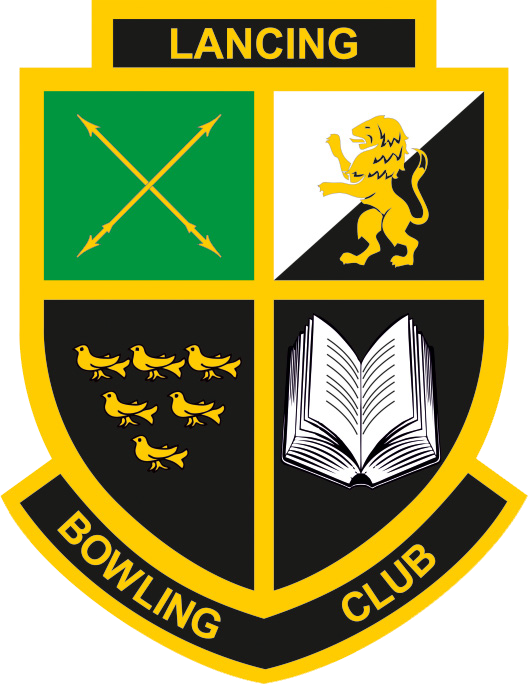
The current club badge and flag, designed by Bill Harling, beautifully reflect the heritage of both the club and the village. The crossed lances symbolise the local oak forests that once supplied the timber required to fuel furnaces used in making lance heads. The rampant lion is taken from the coat of arms of the Lloyd family, who built and lived in the Manor House. The martlets represent the six traditional birds featured on the Sussex County flag, with the current wall plaque depicting all six created by Rodger Boakes. Finally, the Book of Learning honours Lancing College, which owned the Manor Estate following the Lloyd family.
Together, these symbols tell the story of a club deeply connected to its village, proud of its past and looking confidently towards the future.